
<img src="https://secure.tool3sign.com/182543.png" style="display:none;">
digital mesh in blue with dotted highlights being connected-1

Event-Driven Architecture

Event‑Driven Architecture (EDA) is a modern approach to connecting IT systems. Instead of using fixed, point‑to‑point integrations, applications collaborate by reacting to events. When something happens for example, an order, a payment or a change in data systems respond immediately and independently.

This integration style makes organisations more flexible, scalable and ready for change. New functionality can be rolled out faster, processes remain agile and disruptions have less impact. EDA therefore provides the technological foundation for organisations that want to continue growing and innovating.

Collaborations that drive innovation

logo-hbm (1)
Tonys-Chocolonely-Logo-White
Sibbing-Logo-White
multiple connections of digital systems-1

What is an Event-Driven Architecture?

Event‑Driven Architecture (EDA) is a system architecture in which applications communicate with each other by means of events. Instead of direct, fixed integrations, applications share information about what is happening within their own domain. Each service publishes events that may be relevant, while other services only listen to the events that matter to them. This creates a decentralised way of collaborating in which components continue to operate independently.

This approach differs fundamentally from traditional point‑to‑point integrations, where application A sends a direct request to application B to retrieve data. In EDA, a service simply announces what has taken place, and all systems that need to respond to it automatically receive that information. Because of this loose coupling, the IT landscape gains flexibility, scalability and resilience.

generated-image (3)

How does EDA work?

Event‑Driven Architecture (EDA) lets systems collaborate by responding to events, such as an order being placed or stock being updated, which generates an event. An event broker then ensures these events are automatically routed to the right consumers, so services can react immediately or trigger new events.

Event queues can temporarily store events so that no messages are lost if a service is briefly unavailable, creating a flexible set of loosely coupled systems that continue to work together efficiently.

Common patterns within EDA include Publish/Subscribe, where a single event is delivered to multiple systems at the same time, and Event Streaming, where a continuous stream of events is processed and analysed in real time.

Benefits of EDA

Event‑Driven Architecture (EDA) offers organisations a range of structural benefits. It enables faster responses to change, more efficient use of resources and significantly accelerates innovation. These benefits make EDA a strategic foundation for organisations focused on innovation, agility and digital maturity. It provides the flexibility and robustness needed to grow sustainably in a rapidly changing digital world.

Realtime decision-making

With EDA, your organisation responds directly to what is happening. All relevant systems receive the same information at the same time, enabling fast and accurate decision‑making. This leads to better operational performance and a stronger, more consistent customer experience.

Accelerated innovation

New features and applications are easier to integrate in an event‑based environment. By building on existing events, new developments can be delivered much faster, work that previously took weeks can now be completed in days. This shortens time‑to‑market and encourages continuous improvement.

Agile process automation

Processes run dynamically, without rigid workflows or manual triggers. Systems respond automatically to events, which reduces manual work and increases efficiency. This agility makes it easier to adjust processes when business requirements change.

Reliability through decoupled services

Because services operate independently, systems become more stable. A failure in one component does not bring down the rest, which significantly increases overall reliability. This isolation of failures also simplifies troubleshooting and recovery.

Scalability under peak load

Parts of the system can be scaled independently when demand increases. This allows more efficient use of resources and prevents unnecessary overcapacity. As a result, your architecture can handle peaks in usage without performance degradation.

Fewer system dependencies

By reducing the number of direct, point‑to‑point integrations, the IT landscape becomes easier to manage. This lowers the risk of errors, speeds up maintenance and makes it simpler to replace or upgrade technologies. The result is a cleaner, more future‑proof architecture.

Connector puzzle

When is EDA needed?

Event‑Driven Architecture (EDA) is useful when your IT landscape can no longer keep pace with market speed, systems do not communicate in real time, decisions rely on outdated data or information is fragmented across departments. In these situations, EDA enables consistent, instantaneous data exchange throughout the organisation.

By decoupling services and letting them collaborate via events, new features can be developed and integrated more quickly. This creates a flexible and scalable IT landscape that accelerates innovation and helps the organisation respond more effectively to change.

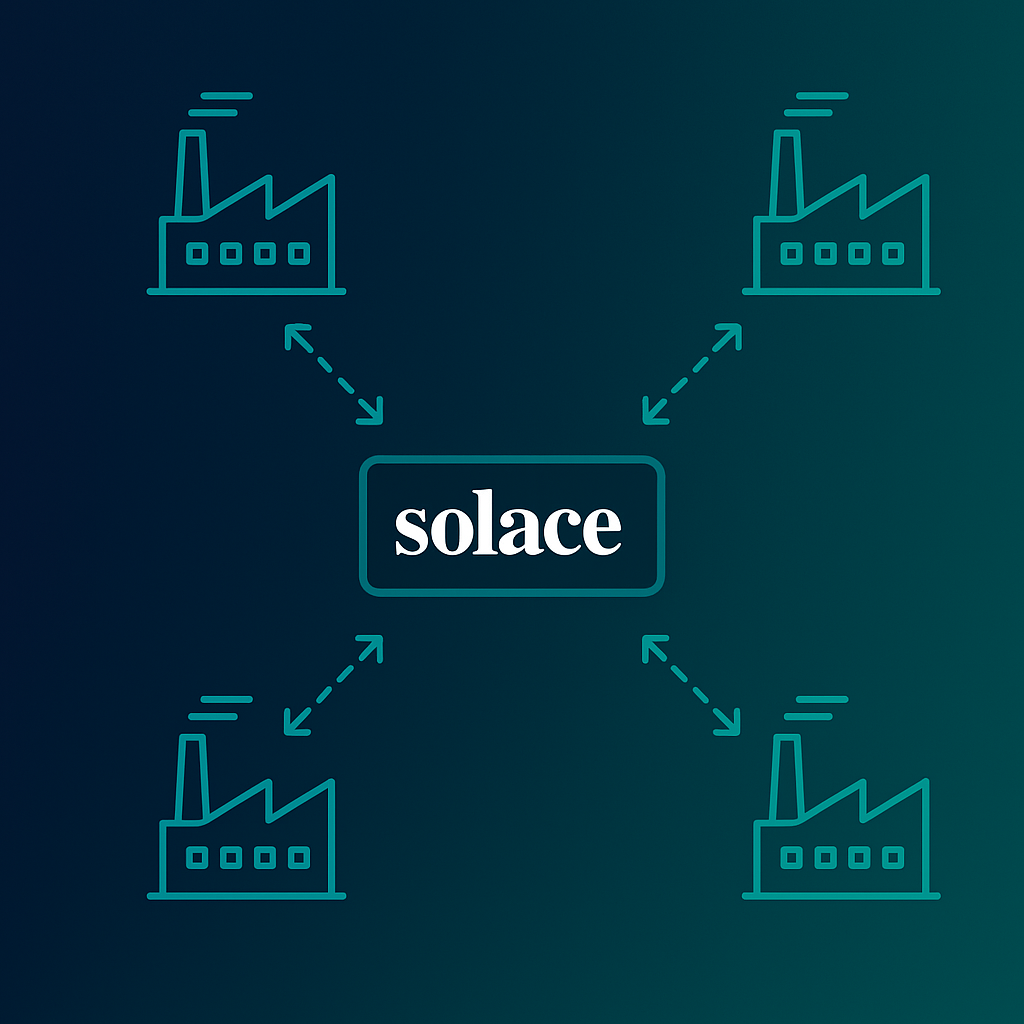
Solace-event-mesh

Solace

Solace is a platform for event‑driven data exchange that helps organisations put Event‑Driven Architecture (EDA) into practice. It provides an event broker and management tools that let you stream events reliably, securely and in real time between applications, systems, devices and cloud environments.

Solace acts as the central event layer in your architecture: it receives events from producing systems and automatically delivers them to the right consumers. This prevents spaghetti‑style integrations and gives you one consistent way of distributing events. In addition, Solace supports governance and visibility: with the Event Portal you can model your event‑driven landscape, catalogue events and data flows, and gain better insight into which applications produce and consume which events.

iPaaS

Accelerate digital transformation with an Integration Platform as a Service (iPaaS). Connect applications, automate processes and manage integrations centrally in a secure, scalable and cloud‑native way.

API Management

Bring data and services to life via APIs. Create secure connections between systems, unlock new opportunities for innovation and improve collaboration inside and outside your organisation.

Master Data Management

Establish a single, trusted source of truth. With Master Data Management you ensure consistent, up‑to‑date master data that strengthens decision‑making and operational efficiency.

FAQ

What is an event?

An event is a significant moment within a system that indicates something of importance has happened. It can automatically trigger other processes or actions, without systems being directly dependent on one another.

An event contains two essential pieces of information: what happened and when it happened, which makes events traceable, easy to analyse and immediately usable in business processes. At its core, an event is a data carrier that exposes relevant information to any systems that need to react to it.

What is the difference between microservices and event driven architecture?

Microservices are mainly about how you structure an application: you break a large application into multiple small services, each with its own responsibility, which usually communicate via direct API calls.

Event driven architecture focuses on how systems communicate: not via direct requests, but via events that say “something has happened”, which other systems can listen to and respond to.

You can have microservices without EDA, but also microservices that collaborate in an event driven way.

Why is event driven architecture important?

Event‑drivenarchitecture is important because it allows systems to remain loosely coupledwhile still collaborating effectively. That makes it easier to connect newsystems, scale under heavy load and respond quickly to what is happening inyour organisation at any given moment. This loose coupling improvesscalability, resilience and flexibility across the IT landscape.

digital-transformation-3-2048x1152

Discover how Emixa can transform your business

What is an event?

An event is a significant moment within a system that indicates something of importance has happened. It can automatically trigger other processes or actions, without systems being directly dependent on one another.

An event contains two essential pieces of information: what happened and when it happened, which makes events traceable, easy to analyse and immediately usable in business processes. At its core, an event is a data carrier that exposes relevant information to any systems that need to react to it.

What is the difference between microservices and event driven architecture?

Microservices are mainly about how you structure an application: you break a large application into multiple small services, each with its own responsibility, which usually communicate via direct API calls.

Event driven architecture focuses on how systems communicate: not via direct requests, but via events that say “something has happened”, which other systems can listen to and respond to.

You can have microservices without EDA, but also microservices that collaborate in an event driven way.

Why is event driven architecture important?

Event‑driven Architecture is important because it allows systems to remain loosely coupled while still collaborating effectively. That makes it easier to connect new systems, scale under heavy load and respond quickly to what is happening in your organisation at any given moment. This loose coupling improves scalability, resilience and flexibility across the IT landscape.

Prepare your IT landscape for change.