Published date: November 2, 2026

Where SAP transformations lose control
SAP transformations rarely stall on technology alone. The biggest risks arise when the scope keeps shifting, responsibilities are unclear, decisions are postponed, or users are involved too late. Complexity and customisation then grow, the schedule and budget come under pressure, and you risk ending up with a solution that works technically but doesn't deliver enough business value.
Throughout a programme like this, organisations have to make choices constantly. Do we follow the SAP standard or deviate from it? Which (local) needs are genuinely essential? And who decides when interests clash? Perhaps you recognise this from your own project: decisions that stay open for too long, or key users who are only brought in once testing starts. Without clear ground rules, bottlenecks like these lead to rework, extra costs and longer lead times. A successful transformation therefore calls for an approach that speeds up decision-making, makes risks visible and aligns business, IT and users around the same goal.
SAP Activate provides a proven framework for this. At Emixa, our SAP-certified consultants combine in-depth knowledge of this methodology with experience from SAP projects. Our expertise goes beyond the functional configuration of SAP: we bring together process knowledge, project management and change management. That way, we help organisations apply fit-to-standard as far as possible, keep decision-making sharp and involve users in the change from the start. In this blog, we explain how the six phases of SAP Activate bring structure, what it takes to get the most out of the methodology, and how we do that in practice.
How SAP Activate guides a transformation direction
SAP Activate is SAP's official methodology for implementing SAP S/4HANA and other SAP solutions. It brings the entire project together: from defining the intended business value and the initial scope through to go-live, stabilisation and ongoing optimisation.
The approach combines SAP Best Practices, supporting tools and a phased project methodology. At its core is fit-to-standard: start from what SAP offers as standard, and only deviate when there is a clear business, legal or operational reason to do so. That conversation is often more important than the configuration itself, because it determines how much complexity the organisation will have to maintain later on.
SAP Activate consists of six phases. They follow on logically from one another, but they are not a rigid step-by-step plan: insights from a later phase can reopen earlier choices. The real added value lies in the clear decision points, fixed deliverables and shared expectations for each phase.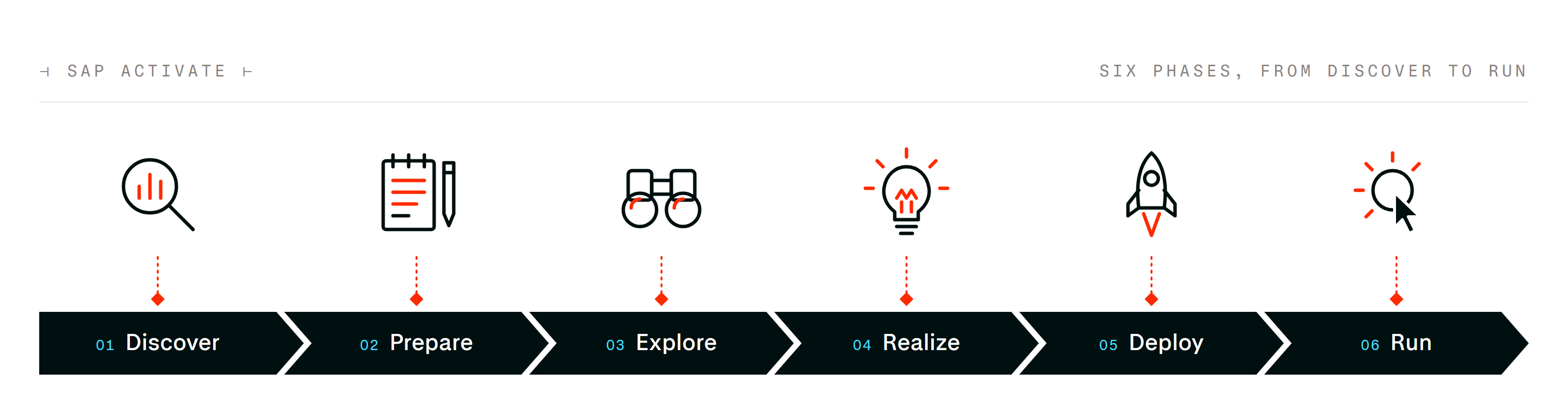
Below, we explain what SAP Activate provides in each phase and where we place extra emphasis, including through EMBRACE, our own change management approach.
- Discover — The organisation maps out its objectives and the expected business value, defines the initial scope and chooses a suitable SAP solution and implementation strategy. Tools such as the Digital Discovery Assessment support this analysis. Our focus: we start the change approach as early as this phase, so the organisation understands why the change is needed.
- Prepare — The joint project organisation and governance are set up: core team, roles, schedule, meeting structure and system access. Data, integrations and testing are given a place in the project approach. Our focus: together with the organisation, we agree who makes which decisions, which topics the steering committee covers and how the change approach translates into concrete actions for communication and engagement.
- Explore — In fit-to-standard workshops, we demonstrate the standard processes directly in SAP to process owners and key users. Using these demos, we compare how the standard works with what the organisation needs. For every deviation, the reason, the impact and the decision are recorded. Our focus: we test every deviation against the underlying need.
- Realize — The design is turned into a working solution: configuration, extensions, integrations and trial migrations. Testing and user acceptance testing (UAT) follow. Our focus: key users don't just test; they also prepare their colleagues for the new way of working.
- Deploy — The final data is migrated and the cutover is carried out. After a formal go/no-go decision, the system goes live. Our focus: we base the go/no-go not only on the technical status, but also on whether the organisation and its users are ready.
- Run — After go-live comes hypercare, followed by business-as-usual support and continuous improvement. With SAP S/4HANA Cloud Public Edition, for example, the periodic updates have to be assessed and tested in advance. Our focus: we make sure the new way of working becomes embedded, so users don't fall back into old habits.
Thanks to this fixed structure, teams know which milestones, roles and deliverables belong to each phase. That makes collaboration easier, speeds up onboarding and provides an approach that has already proven itself across a wide range of SAP projects. The method doesn't replace experience or sound project management, but it does provide a solid shared starting point.
From methodology to results: SAP Activate in practice
In practice, the value of SAP Activate lies not only in the six phases, but above all in how we work with them. At Emixa, we translate each phase into concrete agreements: which decisions need to be made, what input they require, and who owns them? Drawing on our experience across a wide range of SAP projects, we look beyond the formal roadmap. For example, we recognise when a debate about functional details actually points to unclear ownership, a scope that isn't tightly enough defined, or a decision being made at the wrong level. By surfacing these signals early, we stop them from causing delays during build or testing.
During fit-to-standard workshops, we demonstrate the standard processes directly in SAP. This lets process owners and key users see exactly how the process runs as standard and test it against the organisation's needs. So we don't start by asking how to replicate the current process in SAP; we first map the underlying business need. Where the standard falls short, we record the gaps and look for the best answer to each one: adapt the organisation's own process to the standard, or make a deliberate choice for customisation. This helps organisations choose their deviations deliberately, instead of adding them along the way.
A real-world example:
At an international manufacturer of high-tech components, we facilitated the fit-to-standard workshops for S/4HANA Cloud Public Edition, covering the Finance, Procurement, Supply Chain, Manufacturing and Sales modules. Together, we looked at what was really needed. In some areas, the organisation adapted its way of working to the SAP standard; in others, it deliberately chose customisation. This keeps the scope manageable and limits customisation to where it genuinely adds value.
We also place deliberate emphasis on day-to-day project management. A progress report showing a green percentage says little if critical decisions are still open. That's why we link status to tangible elements: approved deliverables, validated processes, test results, risks, and decisions with a clear owner and deadline. This keeps the backlog an active management tool. Not every item needs to be resolved straight away, but we make sure every item is visible and prioritised.
We apply the same pragmatic approach to the human side. Key users play an active role in our projects: they test processes, flag bottlenecks and prepare their colleagues. With EMBRACE, our own change management approach that turns the proven Kotter and ADKAR models into concrete activities, these actions run alongside every SAP Activate phase.
SAP Activate as a starting point
SAP Activate gives organisations a shared framework for steering their SAP transformation with purpose. It brings the business, IT and the implementation partner together around clear choices on business value, standardisation, scope and risk. Whether that framework actually works depends on how it is applied in day-to-day project work: who decides, how deviations are assessed and how users are brought along in the change.